
In December 2017, Dominic Fike released his first collection of demos while serving time in a Florida jail. The songs began attracting attention, but he couldn’t see how many people were listening or respond to his friends. He had spent months recording the music and was now unable to follow what happened to it.
Nearly nine years later, the situation could hardly be more different. In October 2026, Fike launched a round-the-clock streaming channel featuring concert films, original shows and footage from his latest tour. He also invited fans to follow the making of his third studio album, How to Quit Smoking, which arrived on October 30.
It is a remarkable change for someone who once made a point of deleting his older recordings. Yet Fike’s history shows that he has never simply wanted as much attention as possible. What matters to him is having some control over how people discover his work.
Why Dominic Fike Deleted His Early Music
Before “3 Nights” introduced him to a wider audience, Fike was already known around Naples, Florida. He had performed with local rap collectives, released songs online and developed a following in his hometown.
But he wasn’t particularly interested in preserving everything he had made.
In a January 2019 interview with Pigeons & Planes, Fike explained that he regularly deleted previous collections whenever he released something new.
He followed a similar approach when preparing Don’t Forget About Me, Demos, asking his team to remove the older material before the project appeared. As he recalled:
“Before you drop it, wipe everything.”
His reasoning was personal. He had already become familiar to listeners in Naples and wanted an opportunity to introduce himself differently.
The circumstances surrounding the EP made that ambition difficult to control.
Fike had recorded the songs while under house arrest. His manager, David Fernandez, helped him obtain recording equipment, and the original plan was far more ambitious than the six-track project that eventually emerged. Fike initially imagined 17 songs, each accompanied by visuals, forming something like a feature-length film.
That plan was interrupted when he went to jail for violating the conditions of his house arrest.
The demos nevertheless appeared online in December 2017 and attracted considerable industry attention. By the summer of 2018, his available music had been taken offline as a record deal with Columbia Records came together.
The disappearance added to the mystery surrounding him. As The New Yorker later observed, there was an understanding among those managing his career that scarcity could help generate interest.
The Columbia re-release finally arrived on October 16, 2018.
What began as Fike’s attempt to move beyond his local reputation had become part of a much larger introduction to the music industry.
He Wanted the Music to Speak for Him
As Fike became more recognisable, especially after appearing in HBO’s Euphoria, he encountered another problem. People were forming opinions about him without necessarily knowing much about his music.
In a 2023 interview with VMAN, he explained that his newer audience hadn’t witnessed the changes he had undergone since his early career.
He also acknowledged that being relatively inactive online sometimes made communication difficult. Rather than repeatedly explaining himself through Instagram statements, he preferred to reach people through songs.
That preference helps explain why he played unreleased material during his 2022 tour. He wanted newer fans to become familiar with him through his work.
The approach became more unusual in April 2024.
Instead of announcing a conventional single or album, Fike invited a small audience to a warehouse in West Hollywood for a presentation called 14 Minutes.
Fans were directed to the event through Instagram and text messages. When they arrived, they found a large truck being used as a projection screen.
The presentation consisted of a short film, directed by Jack Begert, showing Fike running while eight previously unreleased songs played continuously.
There were no elaborate music-video narratives or clearly separated performances. For fourteen minutes, the songs accompanied the same moving image.
At the event, Fike explained that he had grown frustrated with the industry’s expectation that musicians should hold on to recordings for years before making another major release. He wanted people to hear music he loved without waiting for the next carefully planned album cycle.
As Rolling Stone reported, the project initially appeared as a complete film on YouTube rather than as individual streaming tracks. The eight-song EP subsequently reached streaming services on May 3, 2024.
It was another example of Fike choosing the terms of a release. In 2018, he had removed music to create a fresh introduction. With 14 Minutes, he was releasing music sooner than the conventional schedule might have allowed, but still choosing a very specific way for audiences to experience it.
Separate Street Brings the Audience Into the Process
Fike took the experiment further with How to Quit Smoking.
He announced the album while preparing for his Comedy Tragedy Parody tour in August 2026. Rather than completing the entire record before travelling, he began writing and recording much of it between performances.
Hotel rooms, tour buses and backstage spaces became temporary studios. Videos were filmed in different cities, with the releases following the tour’s movements.
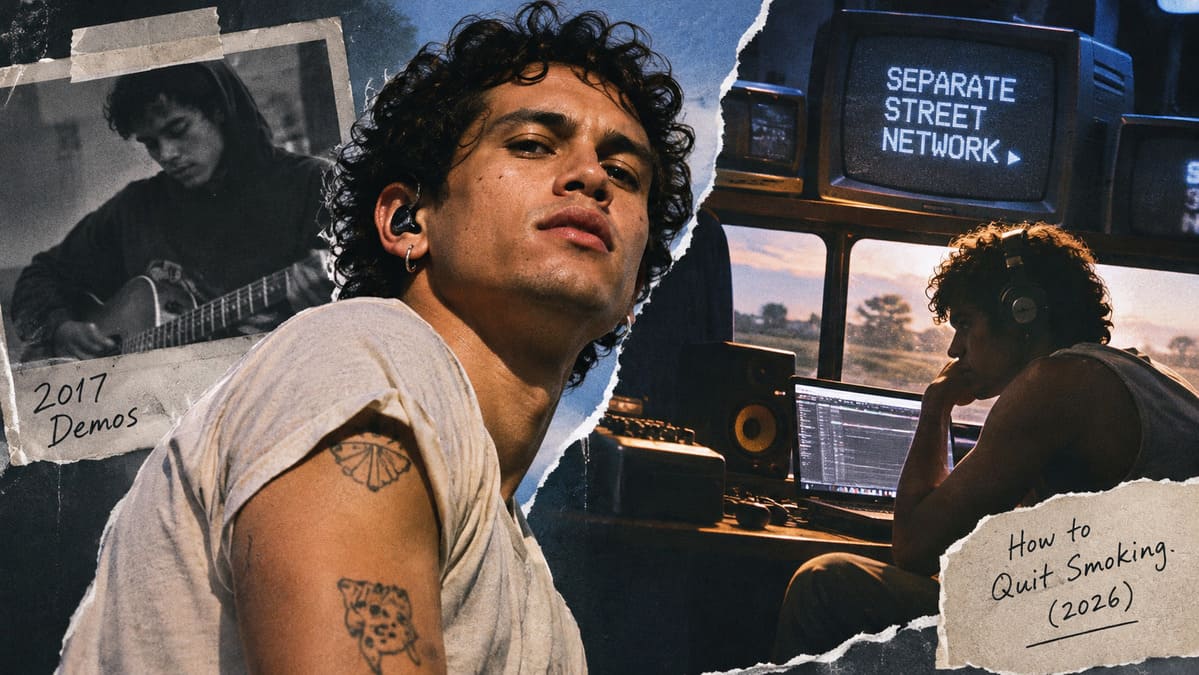
An Instagram account called Separate Street documented the process, allowing fans to see portions of the album’s development.
The most ambitious part arrived on October 19, when Separate Street announced its own 24-hour streaming channel.
Its creators weren’t trying to reproduce YouTube or Netflix. In the launch announcement, they expressed affection for the scheduled television they had grown up watching, naming channels such as MTV, Cartoon Network, BET and VH1.
They missed the experience of switching on a television and discovering whatever happened to be playing.
“The algorithms just don’t hit the same,” the announcement explained.
The network offered a mixture of projects developed during Fike’s tour. These included Line Culture, a show about the shared experience of waiting; October Ninth, which explored conflicts during the creative process; and How to Move, a series of short dance films previewing new music.
It also promised concert films from every headline date of the North American tour, along with footage of smaller performances and unexpected encounters between shows.
Crucially, viewers weren’t guaranteed instant access to everything. Shows had scheduled premieres, and anyone who missed one might need to catch a rerun.
That decision reveals something distinctive about the project. Even while offering more access to his creative world, Fike and his collaborators were deciding how that access should work.
There was another difference from ordinary album promotion.
On October 21, Separate Street announced that it was interrupting scheduled programming to stream from Texas as Fike and his collaborators continued finishing the album. Another update on October 25 advertised a livestream devoted to the final touches.
The audience was no longer encountering only the finished music. It could follow selected moments of the work that produced it.
What Has Actually Changed?
The difference between Fike’s early releases and Separate Street might suggest that he has become completely comfortable with public attention. His own comments tell a more complicated story.
In an October 2026 conversation with filmmaker Curry Barker, Fike discussed his discomfort with streaming statistics and the pressure created by other people’s expectations.
He also explained that constant publicity can make it harder for audiences to separate an actor from the public personality they already recognise. Having appeared in Euphoria, he wondered whether his music career might affect how viewers received him in another role.
Yet he spoke enthusiastically about the creative process itself. Songwriting, he explained, is one place where outside pressure tends to disappear.
These feelings are not necessarily contradictory. Fike can enjoy sharing his music while wanting greater control over how much of himself audiences see.
The evolution of his releases suggests a consistent interest in that distinction.
In 2018, he wanted to escape the identity attached to his earliest recordings. In 2024, he rejected the idea that finished songs should remain unheard until the next conventional album campaign. In 2026, he helped create a platform that allowed fans into the recording process while still offering a deliberately curated experience.
The release of How to Quit Smoking brings those approaches together. The album was shaped by the tour, documented while it was being made, and shared through a platform built around Fike’s creative interests.
It would be too simple to describe this as an artist who once avoided attention but now embraces it.
Dominic Fike has always wanted people to hear his music. What has changed is how he chooses to let them in.