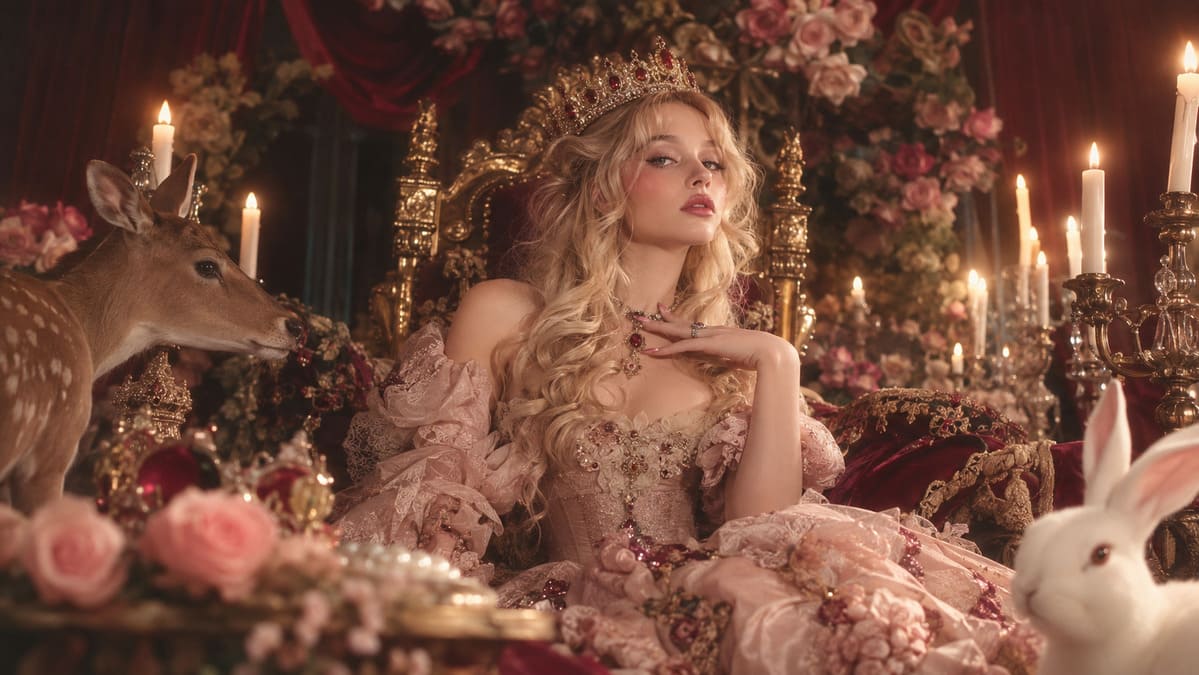
Fairy tales have traditionally asked girls to endure. Stay kind through the cruelty, preserve something innocent inside yourself, and eventually the story will reward you with recognition, rescue or some version of happily ever after. Mollie Elizabeth has never seemed particularly convinced by that bargain, even while building her music from the dresses, woodland creatures, princesses and old-Hollywood romanticism that once made it so seductive.
On “Kiss The Ring,” released October 2 ahead of her forthcoming People Pleaser EP, she finally breaks the bargain altogether. The young woman at the centre of the song has no interest in waiting for someone to discover that she deserves better; she wants the crown, the carriage, the jewels, the authority and the room’s undivided attention, transforming childhood disappointment into something deliciously close to tyranny. The song has been introduced as a cabaret anthem for those whose childhood fantasies collided with grim realities, and Elizabeth herself has described fantasy as a way she learned to find beauty inside difficult circumstances.
That makes the song’s excess more important than it first appears. “Kiss The Ring” is easy to enjoy as a mischievous self-coronation, but heard beside “Dog Eat Dog,” “Run Rabbit,” “Puppet Show” and “Petty Crimes,” it sounds like the culmination of a much longer argument about what happens to softness when the world continually asks it to defend itself. The prey becomes the monarch, the performer takes control of the stage, and the girl who kept trying to be heard stops explaining herself altogether.
The girl with the crown used to be the prey
Elizabeth has been preparing this transformation for months, although the earlier songs did not necessarily make it look like a coronation was coming. “Dog Eat Dog” begins much closer to a warning delivered to a child, imagining girlhood as an education in the difference between innocence and safety and gradually replacing bows and playfulness with claws, strategy and the recognition that some people see vulnerability as opportunity.
The most revealing connection with “Kiss The Ring” may be just three words: “girls like me.” In “Dog Eat Dog,” those words identify the sort of girl who gets preyed upon; in “Kiss The Ring,” they identify the sort of girl who deserves to be moved to the front of the royal procession. The category has not changed, but its position in the hierarchy has.
Elizabeth’s own explanation of “Dog Eat Dog” makes that reversal harder to dismiss as coincidental. She has described the song as an acknowledgement that the natural world can be brutal without being malicious, while humans are capable of hurting one another for reasons that go far beyond survival; in another interview, she framed the song around the uncomfortable recognition that trying only to cultivate peace can leave someone exposed to people willing to exploit it.
“Kiss The Ring” does not answer that dilemma by rediscovering innocence. Instead, it imagines what happens when the girl who had to learn about predators decides she would rather occupy the safest position in the food chain. The transformation is intentionally too large to function as ordinary self-confidence, which is precisely why it works: the crown becomes an emotional overcorrection for a world in which gentleness repeatedly came with a cost.
The physical imagery connects the songs too. “Dog Eat Dog” imagines a girl discovering the claws necessary for survival, “Run Rabbit” turns escape itself into a desperate act of clawing out, and “Kiss The Ring” opens with the aftermath written onto the body, damaged hands arriving before the jewellery that will eventually adorn them. The ring is therefore not placed on an untouched hand; symbolically, at least, power arrives after the fight.
“Run Rabbit” had already crowned her
The royal language in “Kiss The Ring” is new in scale, but not in origin. At the end of “Run Rabbit,” Elizabeth makes a tiny alteration to a repeated description of herself and suddenly announces, “I’m a monarch,” a shift easy to miss inside a song far more obviously concerned with childhood, survival and the damage left behind after escape.
Elizabeth has described “Run Rabbit” as a dark look at growing up in an unhealthy household and at the moral confusion that can follow it: if circumstances teach a person destructive ways of coping, where does explanation end and responsibility begin? The whimsical march, nursery-rhyme momentum and Alice in Wonderland-inspired visual world do not soften that question so much as give Elizabeth a language in which she can approach it without surrendering the playfulness central to her work.
That fleeting monarch in “Run Rabbit” matters because “Kiss The Ring” expands her into an entire character. The earlier song contains a girl insisting that she was good while simultaneously admitting that getting out required something more feral; the later song is no longer concerned with proving goodness at all. Instead of asking for forgiveness, the narrator demands recognition.
It is one of the most interesting evolutions in Elizabeth’s recent writing because the change is not presented as clean healing. She does not move from damaged child to serene adult, nor from fear to some polished vocabulary of self-care. She moves from survival to fantasy, and the fantasy is enormous enough to reveal how much power the earlier songs were missing.
The title People Pleaser changes the entire song
“Kiss The Ring” will close the six-song People Pleaser EP when it arrives October 30 through Capitol Records, following “Gimme More!,” “Run Rabbit,” “Puppet Show,” “Bang Bang” and “Petty Crimes.” Four of those tracks are currently available, so any reading of the complete project remains necessarily unfinished, but making this song the endpoint already gives its royal fantasy another dimension.
A people pleaser learns to monitor a room. She notices what others need, anticipates disappointment, adjusts herself and often treats harmony as something she is personally responsible for maintaining. “Kiss The Ring” imagines the exact opposite arrangement: instead of shaping herself around everyone else, Elizabeth’s narrator fantasises about a room that must shape itself around her.
That is why reducing the chorus to self-love misses some of its bite. Self-love would require the narrator to stop measuring her worth through other people’s responses; monarchy gives her something much more theatrical, a world in which those responses become compulsory. The former people pleaser does not simply withdraw from the transaction, she reverses its direction.
The key emotional shift is therefore from accommodation to command. Elizabeth’s narrator has grown tired of giving, observing and waiting for life to arrive, so she imagines an existence in which desire no longer requires negotiation. It is funny because the entitlement is knowingly extravagant, but it is also psychologically legible: when ordinary control has felt scarce, absolute control can become an intoxicating fantasy.
“Puppet Show” asks who gets to write the character
That idea becomes sharper beside “Puppet Show,” one of Elizabeth’s most explicit songs about performance. The track takes impossible beauty standards and turns them into grotesque theatre, with a woman being altered until she can fit the part expected of her; its visual language draws from the cosmetic-surgery nightmare of The Twilight Zone episode “Eye of the Beholder,” surrounding the pursuit of perfection with the unease of a medical procedure.
Elizabeth has spoken about the song in wider terms than appearance alone. In an interview with LO’AMMI, she argued that women are repeatedly expected to perform a particular character, somehow remaining beautiful, interesting and formidable without losing the niceness and consideration expected of them. “Puppet Show” therefore concerns more than changing a face; it is about the exhausting negotiation between being visible and remaining acceptable.
“Kiss The Ring” does not leave performance behind. It simply changes who gets to direct it.
Royalty is itself an elaborate role, complete with costume, posture, ceremony, an audience and a set of rules about how everyone in the room should behave. The difference is that this time Elizabeth’s character appears to have authored the part herself, which turns the crown into a symbol not merely of status but of creative control.
That distinction fits Elizabeth particularly well because she has never treated hyperfemininity as evidence of passivity. Her aesthetic draws on the visual vocabulary of princesses, vintage Hollywood, old films and childhood dress-up, but she has described that stylisation as escapism and imaginative world-building rather than an attempt to recreate some supposedly simpler version of femininity.
In that context, “Kiss The Ring” does something more interesting than reject the princess. It lets her become dangerous.
“Petty Crimes” explains why she stops asking politely
If “Puppet Show” helps explain the obsession with controlling the performance, “Petty Crimes” helps explain the song’s hunger to be taken seriously. Elizabeth wrote the former single out of her experience of repeatedly seeking medical help as a teenager and feeling that her concerns were minimised, misread or treated inadequately until desperation itself became part of the story.
She has been particularly direct about what that experience taught her. Discussing “Petty Crimes,” Elizabeth described reaching the point where becoming disruptive seemed like the only remaining way to make people listen, turning the track’s playful criminal framing into something much sadder: misbehaviour becomes communication when conventional requests for help fail.
That gives “Kiss The Ring” another useful context. Across these songs, attention is unstable: sometimes the girl cannot get enough of it when she needs help, sometimes she receives too much of the wrong kind when her body is being judged, and finally she imagines commanding so much of it that nobody could possibly overlook her again.
The jump from being ignored to demanding worship is deliberately unreasonable, but emotional reactions often are. Elizabeth’s recent songwriting is strongest when it refuses to flatten those reactions into inspirational lessons, allowing the feral, childish, vain, frightened and funny responses to coexist without insisting that every one of them represents the healthiest possible conclusion.
The orchestra makes the fantasy physically bigger
The transformation would not work nearly as well if “Kiss The Ring” sounded like a standard empowerment single. Joshua Murty’s production and Kyle Daniel Gordon’s score production instead give the track a theatrical scale, with piano, guitar, bass, percussion, glockenspiel, celesta, strings, upright bass and a substantial horn section helping to turn the narrator’s private grievance into something closer to a procession.
The contrast is characteristic of Elizabeth’s music. The subject matter may involve family instability, predation, medical dismissal or the violence of beauty standards, but the arrangement rarely approaches those themes with plainspoken solemnity; she prefers ornate spaces in which darkness can wear ribbons, dance, joke and occasionally become absurd.
Elizabeth has explained that philosophy herself, saying she learned young to look at difficult parts of life through rose-coloured glasses and now wants her music to create a place where listeners can encounter beauty and wonder even when everyday reality offers very little of either. She grew up on an isolated mountain in Washington’s Cascade Range, surrounded by nature and by the music her parents loved, including Rosemary Clooney, Doris Day, Connie Francis, The Zombies and The Kinks, influences that help explain why her songs can feel simultaneously old-fashioned and psychologically modern.
“Kiss The Ring” makes that philosophy audible. Rather than stripping pain down to prove its seriousness, the song decorates it until the decoration itself becomes part of the argument.
The celesta and glockenspiel preserve the glimmer of childhood make-believe, while the strings and horns enlarge the fantasy into ceremony. Elizabeth’s vocal performance sits inside that arrangement with a knowing theatricality, treating entitlement as character work rather than simply belting a motivational slogan.
The fairytale has changed jobs
Fantasy once appears to have offered Elizabeth somewhere to hide. She has spoken about growing up isolated in Washington, struggling to fit in at school, spending time in nature and imagining that birds might communicate with her because of her love of Snow White.
That history makes the evolution of her fairytale imagery especially compelling. The child imagines another world because she cannot control this one; the woman in “Kiss The Ring” imagines another world in which control is the defining feature.
The difference separates escapism from authorship. Earlier fantasy creates shelter, while this fantasy redesigns the social order itself.
The song’s gleefully threatening second verse pushes that transformation toward the absurd, with boys warned against challenging the narrator once she reaches the top. There is an obvious Queen of Hearts flavour to the threat, particularly given the Alice-inspired imagery already present in Elizabeth’s visual world, but it is worth keeping interpretation separate from confirmation: Elizabeth has not publicly identified that moment as a direct Queen of Hearts reference.
The association works because the song is interested in what happens when princess imagery curdles into power. Childhood stories are full of good girls waiting for circumstances to improve; “Kiss The Ring” imagines what happens when one of them grows impatient enough to seize the narrative mechanism itself.
The crown is not quite freedom
The easiest reading of “Kiss The Ring” would be a familiar one: a woman suffers, discovers her worth and finally takes her power back. Some of that is certainly present, but the song becomes far richer if the crown is allowed to remain slightly suspicious.
A people pleaser depends on an audience because she needs its approval. A monarch who requires constant admiration still depends on an audience, only under different terms, which means Elizabeth’s narrator may have reversed the power relationship without fully escaping it.
That does not make the fantasy hollow. There is something genuinely exhilarating about hearing the girl from “Dog Eat Dog,” “Run Rabbit,” “Puppet Show” and “Petty Crimes” finally occupy far too much space, particularly because her earlier songs have spent so much time examining what happens when a young woman is hunted, reshaped, dismissed or forced to adapt.
But “Kiss The Ring” does not need to be a model of healthy recovery to be emotionally truthful. Sometimes the first fantasy after powerlessness is not balance; it is excess.
That may be why Elizabeth’s royal character feels more interesting than a straightforward empowerment heroine. She does not calmly establish her boundaries, practise gratitude and announce that she has healed; she covers the wound in jewellery, hires an orchestra and imagines everybody else kneeling.
There is humour in that overcorrection, but also an uncomfortable logic. If suffering has repeatedly been framed as something that should make a girl stronger, wiser or more resilient, “Kiss The Ring” asks why she cannot demand something more tangible for surviving it.
From people pleaser to majesty
The full story of People Pleaser cannot be known until the EP arrives, particularly with “Gimme More!” and “Bang Bang” still capable of altering the path between its beginning and ending. What the released songs already reveal, however, is an artist repeatedly interested in the distance between the roles girls are given and the creatures they become while trying to survive those roles.
“Dog Eat Dog” learns that softness is not always protection. “Run Rabbit” asks what survival can turn a child into, “Puppet Show” examines the violence hidden inside being made acceptable, and “Petty Crimes” turns the failure to be heard into rebellion. By the time “Kiss The Ring” arrives, pleasing everyone else has become the last thing its narrator intends to do.
That is what makes the song such an effective closing statement for a project called People Pleaser. The title initially suggests a person bending herself around other people’s expectations; the final song imagines the opposite extreme, a world bending itself around her.
Elizabeth does not simply give the princess a happier ending. She changes what the princess wants from the story.
She no longer needs somebody to find her, fix her, approve of her or place a crown on her head. She has already crowned herself, and with “Call me majesty,” she makes recognition everybody else’s problem.