

The first Tinashe in the “Too Easy” music video barely survives the opening shoot. A lighting rig malfunctions, she ends up motionless on the studio floor, and the people responsible for the production are suddenly left without their star. Their solution is rather unusual: find another Tinashe.
It’s a ridiculous premise for a song in which Tinashe sounds completely pleased with herself. She’s looking good, people are staring, and anyone bothered by her success can deal with their own feelings. The music is playful enough that none of this sounds particularly serious.
The video, however, has its own sense of humour. Once the original performer is gone, it follows the effort to reproduce everything that made her a pop star in the first place. The rehearsals, appearances, advertisements and carefully arranged public image all need to continue, even if the person at the centre of them has to be manufactured again.
What Tinashe has said about the song
Tinashe doesn’t consider “Too Easy” an entirely serious declaration of superiority. Speaking to NPR’s Juana Summers in September 2026, she described the song as having a “cheeky and almost sarcastic energy.” She was interested in the performance involved in being a pop star and in questioning what that identity means today.
She made the distinction even clearer in her Stereogum cover interview. Much of the attitude on Popstar, she explained, comes from being serious and joking at the same time. Playing an exaggerated celebrity requires committing to the character, even when that character doesn’t reflect how she feels in ordinary life.
That doesn’t mean the confidence is fake. In an August statement accompanying her Express fashion campaign, Tinashe described “Too Easy” as a song about confidence and being comfortable with who you are.
Both sides can be true. She’s proud of what she’s accomplished, and she’s having fun acting like someone who finds the attention almost embarrassingly easy to handle. The exaggeration is intentional.
Tinashe describes the song’s confidence as a performance, not simply a declaration of superiority. The exaggerated attitude is part of how she plays with the idea of being a pop star.
The lyrics begin with a night out
“Too Easy” opens in a crowded club, with Tinashe encouraging the women around her to dance and asking for the volume to go higher. There’s no elaborate story to work through. She wants everyone to have a good time, and she’s impatient for the party to get going.
Then the subject turns to her celebrity status. She dismisses anyone upset by her success with a suggestion that they should seek therapy. It’s a wonderfully arrogant thing to say, particularly because she delivers it so casually. She doesn’t ask why somebody might dislike her or attempt to win them over. Their irritation simply isn’t her problem.
Later, she acknowledges having come a long way and imagines other people resenting her progress. The boasts become more physical as she talks about her clothes, the way she moves her hips and the attention she receives.
There’s a distinction between these lines and a serious account of her relationship with fame. Tinashe isn’t identifying particular enemies or describing a documented feud. She’s playing up the familiar attitude of a star who knows people are watching and enjoys giving them something to talk about.
The song works because she seems to be enjoying herself, without needing the listener to take every boast literally.
The line turns another person’s irritation into their own problem. Instead of defending her success, Tinashe’s narrator treats the resentment as something she doesn’t need to accommodate.
Why making it look easy matters
The most revealing part of the central boast is the word look. Tinashe isn’t explaining how easy her career has actually been. She’s describing how effortless she can make it appear.
That distinction suits her history. After leaving RCA Records in 2019, she spent years releasing music on her own terms before “Nasty” became a major viral success in 2024. In her NPR interview, she recalled how regaining creative freedom helped rebuild the confidence she had lost while trying to satisfy other people’s expectations.
By the time she released “Too Easy” in June 2026, she’d earned the right to have some fun with her achievements.
The song’s production helps sell that attitude. Co-produced by Kimj and Zack Sekoff, it moves on a heavy, bouncy electronic beat, with short vocal phrases that sound almost tossed off. Tinashe doesn’t spend much time dwelling on her accomplishments. She delivers the boast and goes straight back to dancing.
The video has a different perspective on all of this. It puts the preparation, the personnel and the commercial demands surrounding a celebrity on display. The finished performance might look easy, but the operation keeping it going is anything but.
What happens in the music video?
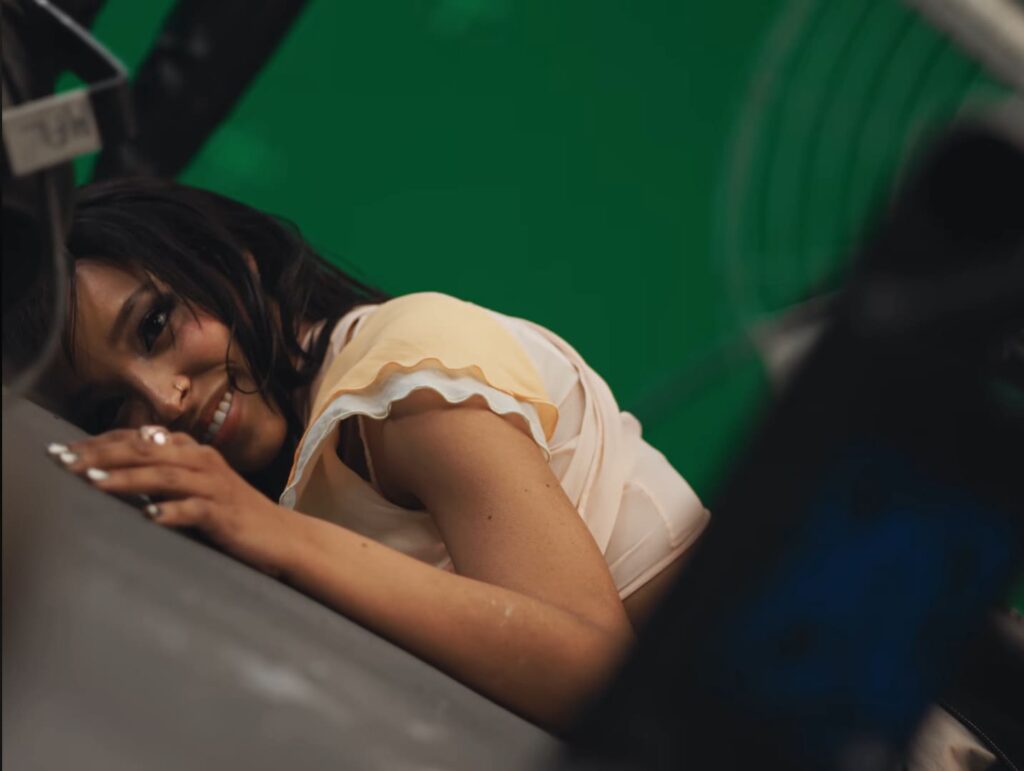
Directed by Onda, with the story and concept credited to Onda and Gaby Dayan, the video begins on a green-screen dance set. An electrical malfunction sends the overhead lighting equipment crashing down, apparently killing Tinashe.
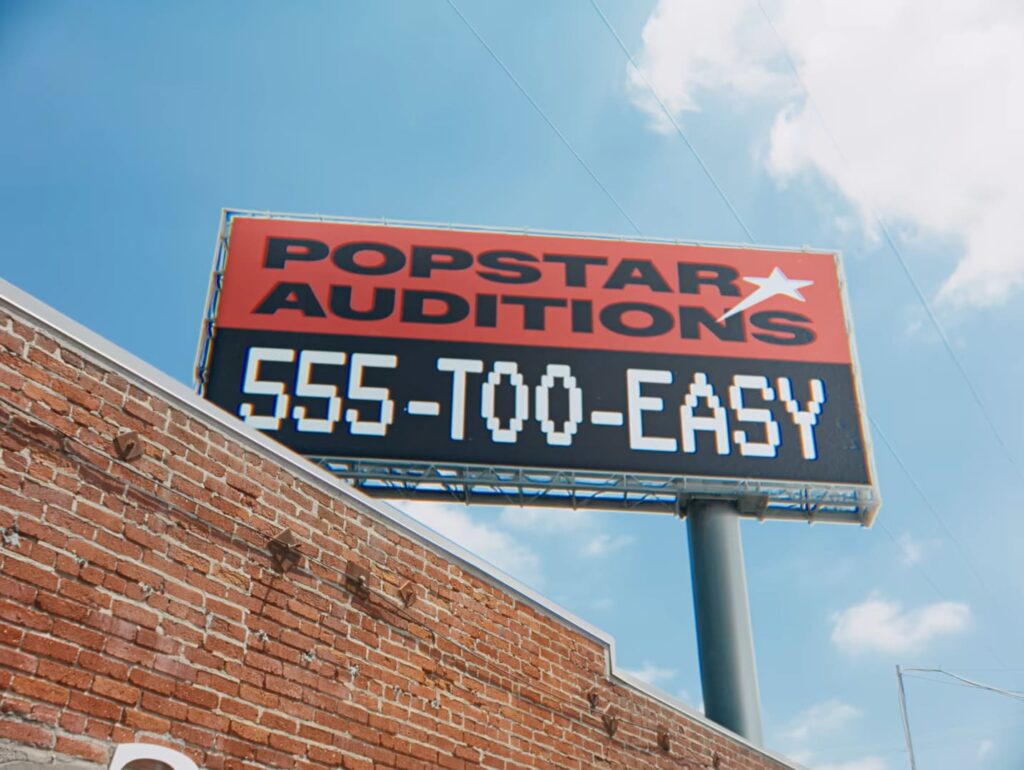
Instead of abandoning the production, the people behind it begin searching for her replacement. A billboard announces pop-star auditions, complete with the fictional number 555-TOO-EASY. Several women audition before a panel, but nobody seems capable of filling the vacancy.
Eventually, the production turns to science fiction. Tinashe appears on a futuristic scanning bed, and a new version of her emerges with a glowing star in her eye.
The official album announcement explicitly describes this process as cloning Tinashe to create the ultimate pop star. The idea isn’t simply that someone else could become famous in her place. The production wants the same face, the same performer and the same recognisable identity.
The recreated Tinashe soon finds herself surrounded by cameras, promotional appearances and production crews. Everything seems back to normal, which is precisely what makes the situation so absurd. The machinery of celebrity has carried on almost without interruption.

The star in her eye, the paperwork, and the cue cards
One of the video’s most interesting details appears during the laboratory sequence. As the recreated Tinashe opens her eye, a pointed star glows inside it. The shape reappears on the paperwork she later signs and in the video’s closing graphic.
The imagery also has a connection to her wider Popstar era. The album cover, photographed by Hugo Comte, features an extreme close-up of Tinashe with stars in her irises. Her Stereogum interview discusses that image in relation to the peculiar experience of fame, where the glamorous public figure and the person living behind that image are not always the same.
Within the video, the recurring star helps identify the newly manufactured performer with the celebrity image being sold. The paperwork adds to that impression, although the documents aren’t readable enough to establish exactly what she’s signing.
The television appearance offers a much less subtle joke. Tinashe sits smiling for the cameras while a crew member holds handwritten cue cards with her lyrics just outside the shot.
It’s a funny little interruption to the fantasy of effortless stardom. The celebrity appears perfectly composed, but somebody standing a few feet away is telling her what to say. The finished image depends on a room full of people whose work is supposed to remain invisible.

A pointed star appears inside Tinashe’s eye during the recreation sequence. Its shape returns elsewhere in the video, visually linking her…
A pointed star appears inside Tinashe’s eye during the recreation sequence. Its shape returns elsewhere in the video, visually linking her new identity to the machinery of pop stardom.

The same star motif appears on the documents Tinashe signs. The recurring design connects her recreated identity with the business…
The same star motif appears on the documents Tinashe signs. The recurring design connects her recreated identity with the business surrounding it, although the documents’ legal terms remain unreadable.
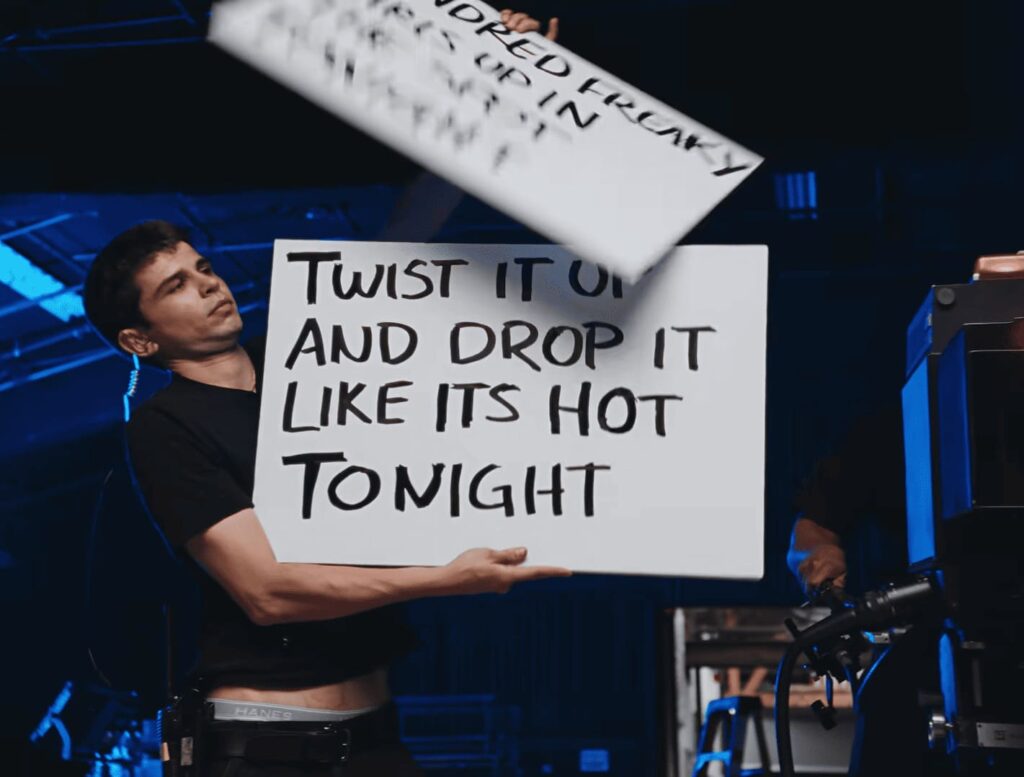
A crew member holds handwritten lyrics just outside the camera’s view. The seemingly effortless television appearance is carefully directed,…
A crew member holds handwritten lyrics just outside the camera’s view. The seemingly effortless television appearance is carefully directed, turning the song’s central boast into a visual joke.
The Hollywood drive is assembled on a set
The video returns to the same idea during the driving sequence. First, we see a white Jeep positioned in front of a green screen, with crew members working around it. Later, the car appears against the Hollywood hills, with the famous sign visible in the background.
The glamorous drive has been constructed for the camera, and the video deliberately lets us see how.
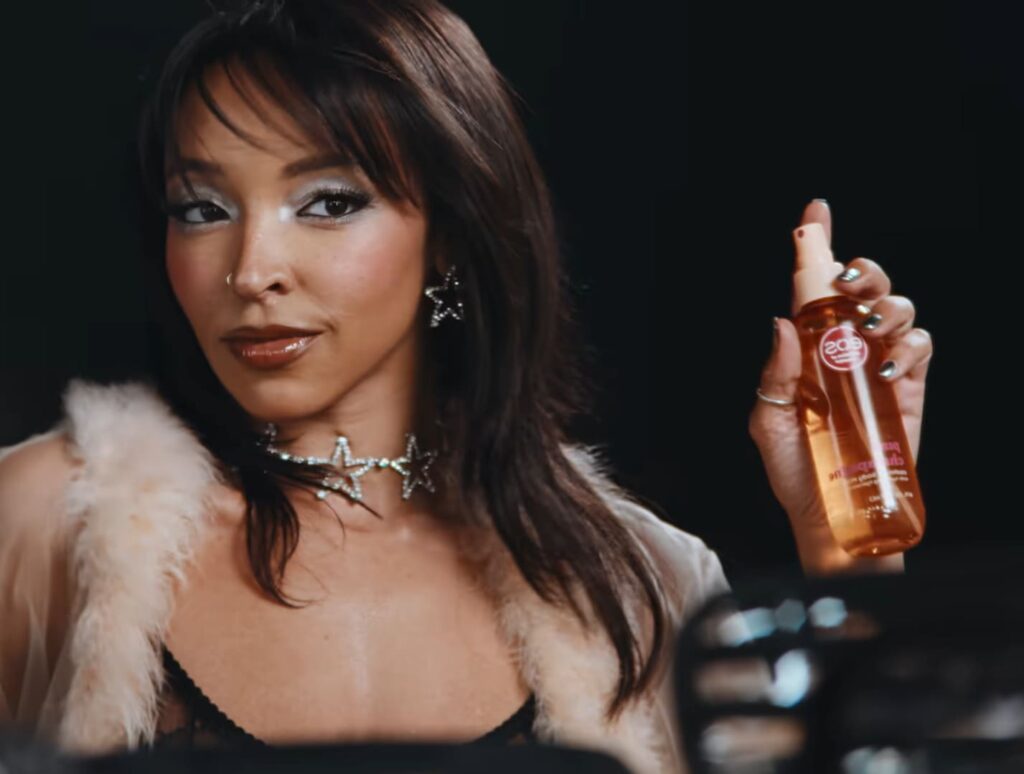
There’s a similar joke in the beauty-product sequence. Tinashe presents an eos Pink Champagne body mist bottle directly to the camera, turning the recreated singer into the face of a commercial almost as soon as she’s back.
Product promotion is, of course, a real part of celebrity work. The video places it alongside interviews, photo shoots and performances, making it one more responsibility the new Tinashe is expected to fulfil.
What’s amusing is how little time the clone gets to enjoy being alive before she’s put back to work. The recreation process promises the ultimate pop star, and she immediately inherits a schedule full of ordinary promotional obligations.


What does the clone represent?
The failed auditions are important because they establish that the production isn’t satisfied with finding another talented woman. It wants Tinashe specifically.
Yet the people arranging her replacement seem less concerned with recovering the person they’ve lost than with restoring the celebrity they need. Once the clone exists, the machinery surrounding her continues as though nothing particularly unusual has happened.
It’s an exaggerated way of showing how much a public figure’s identity can become something other people depend on, organise and sell.
That idea is particularly interesting alongside Tinashe’s own understanding of pop stardom. In her interview with By Alexander, she described the Popstar era as an opportunity to examine and reclaim the title for herself. She rejected the notion that she needed to fit a narrow musical or commercial mould to qualify as a pop star.
The video takes the opposite approach to an absurd extreme. Instead of allowing the performer to define herself, the people around her attempt to manufacture a version that will satisfy their needs.
It’s reasonable to read the clone as a joke about how performers can become inseparable from the images built around them. That doesn’t establish a specific statement about artificial intelligence or any particular entertainment company. The video has plenty to say about the business of being famous without requiring a hidden technological reference.
The strangest part is that cloning solves the production’s immediate problem while leaving everything else untouched. Nobody appears interested in changing the conditions that caused the accident. They simply need someone who can get back in front of the camera.
The failed auditions suggest that the production doesn’t want just another performer. It wants a recognizable version of Tinashe. The clone makes that specific celebrity image reproducible, raising an uncomfortable question: does the industry value the person, or the image it can continue selling?
The ending changes the joke
Near the end, Tinashe is back on a dance set when the lights begin sparking again.
It’s almost the same situation that apparently killed the original performer. The camera looks down at her as she raises her hands, and the screen cuts to black before another impact is shown.
The video never confirms a second death. It doesn’t need to. Returning to the opening danger is enough to suggest that the clone has been sent straight back into the circumstances her predecessor never survived.
That’s a grim ending for such an enjoyable song, but the contrast feels deliberate. Tinashe spends “Too Easy” enjoying the privileges of being noticed, while the video makes fun of the elaborate operation required to keep a celebrity looking permanently ready for attention.
Her own interviews make it clear that she doesn’t reject the appeal of stardom. She enjoys performing, being creative and occupying the spotlight. She’s also interested in examining the expectations that come with it.
The video lets her have both. She can play the impossibly confident star and laugh at the industry that expects her to maintain that image.
By the final scene, the replacement looks exactly right. She can dance, pose, promote products and appear on television. Nobody needs to know how much trouble it took to bring her back.
And then the lights start falling again.

The overhead lights spark again, echoing the accident that opened the video. Tinashe raises her hands toward the camera before the screen cuts to black. The impact itself is never shown, but the repeated danger suggests that even recreating the pop star has not broken the cycle.
Listen with context