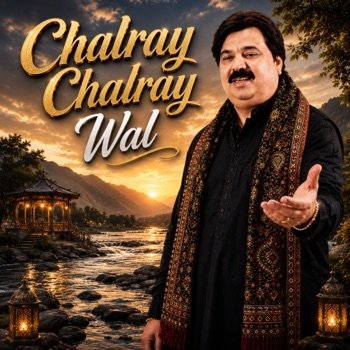
“Chalray Chalray Wal” appears to borrow its central melody from “Na Kajre Ki Dhar,” the romantic duet sung by Pankaj Udhas and Sadhana Sargam in Mohra. That is the strongest explanation for the resemblance identified in the two songs. What remains undocumented is who adapted the tune for the Saraiki recording, when they did so, and whether the original composition was acknowledged. Calling it “copied” without making those distinctions gives a musical comparison the certainty of a confession.
The renewed attention follows Zeeshan Rokhri’s recreation of a song performed by his late father, Shafaullah Khan Rokhri. According to 24NewsHD’s September 9 report, Zeeshan described the release as a tribute to his father. That explains the immediate source of his version. It leaves the older song’s connection to “Na Kajre Ki Dhar” unanswered.
The two lyrics offer different ideas of beauty. “Na Kajre Ki Dhar” praises a woman who needs neither eye makeup nor pearls to be beautiful. “Chalray Chalray Wal” dwells on the details: curly hair, a black shawl draped over the shoulder, a red handkerchief. Its refrain asks who could equal the beloved. The Hindi song dismisses adornment; the Saraiki song takes pleasure in describing it. Even if the tune is borrowed, the words give it a different subject and setting.
The Hindi melody also has a history that the familiar Mohra recording conceals. In a 2023 interview with Bollywood Hungama, Viju Shah explained that Kalyanji–Anandji had composed the song, with lyrics by Indeevar, for a Shashi Kapoor film that was shelved. Mukesh had recorded it. Shah remembered the song from childhood and proposed it when director Rajiv Rai needed a romantic number for Mohra.
Shah altered the arrangement, giving the slow original a livelier rhythm, and brought Indeevar back to write the female sections for a duet. Mohra made the song widely familiar in 1994, but it did not mark the birth of the composition. Shah’s account identifies a specific earlier song and its creators, rather than an unspecified traditional tune.
Dating the Saraiki recording is less straightforward. Spotify lists one release under 2017, while a Rokhri Production single under the spelling “Chalreh Chalreh Val” carries a 2018 date. Those are catalogue dates, not proof of its first performance or recording. They establish that these listed releases came after Mohra; they cannot, by themselves, establish when the Saraiki adaptation began.
The most defensible answer, then, is apparent melodic borrowing from “Na Kajre Ki Dhar,” with new Saraiki lyrics. The documented history of the Hindi composition supports that interpretation. A definitive account of the borrowing still needs testimony or production records from the Saraiki song’s makers. The resemblance has a plausible source. The adaptation has yet to receive a documented history.
Listen with context